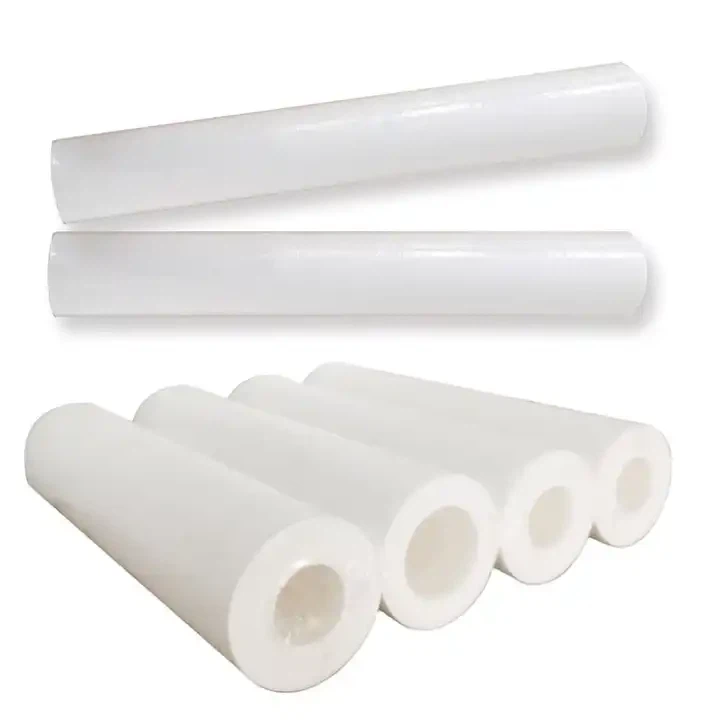
Main types of high-efficiency energy-saving filters
High-efficiency energy-saving filters achieve energy reduction and resource conservation by optimizing structural design, reducing resistance, improving filtration efficiency or extending service life. The following are common types of high-efficiency energy-saving filters:
1. Gradient structure melt-blown filter
Energy-saving principle: The pore diameters of the inner and outer layers gradually change. The outer layer intercepts large particles, while the inner layer performs precise filtration, reducing resistance by more than 30% and increasing dust holding capacity by 50% - 100%.
Application fields: Pure water pretreatment, industrial water, food and beverage filtration.
Advantages: Low pressure, long lifespan, reduced replacement frequency and energy consumption.
2. Large-flow folding filter element
Energy-saving principle: The folding structure significantly increases the filtration area, with a single flow rate of up to 50-80 m³/h, reducing the number of filter elements and system.
Application fields: Large-scale industrial water treatment, power, chemical circulation water systems.
Advantages: High flow rate, time-saving replacement, reduced pumping energy and labor costs.
3. Low-resistance electret filter element
Energy-saving principle: Through electrostatic electret technology, the fibers become charged, efficiently adsorbing PM2.5 and other particles without increasing resistance, with a resistance lower than that of ordinary filter materials by 20%-30%.
Application fields: Air purifiers, air conditioning systems, industrial dust removal.
Advantages: High efficiency, low resistance, energy-saving and cost reduction, especially suitable for long-term operation ventilation systems.
4. High-temperature ceramic membrane filter element
Energy-saving principle: Can directly filter at 400°C - 500°C, without front-end cooling treatment, recovering waste heat from exhaust gas, significantly reducing cooling energy consumption.
Application fields: Chemicals, metallurgy, glass kiln furnace high-temperature exhaust gas treatment.
Advantages: High temperature resistance, long lifespan, achieving heat recovery and ultra-low emissions.
5. Nano-fiber composite filter element
Energy-saving principle: The nano-fiber layer is extremely thin, with high filtration accuracy and low resistance, good air permeability. Under the same filtration efficiency, the pressure drop is 30% lower than that of traditional filter materials.
Application fields: Precision air filtration, masks, clean rooms, automotive air conditioning filters.
Advantages: High efficiency filtration, low energy consumption, balancing protection performance and comfort.
6. Anti-pollution reverse osmosis membrane element
Energy-saving principle: The membrane surface modification enhances anti-pollution performance, reducing cleaning frequency and system pressure drop, and lowering the energy consumption of the reverse osmosis system operation.
Application fields: Seawater desalination, pure water production, wastewater reuse.
Advantages: Resistance to pollution, long cleaning cycle, energy and water conservation.
7. Metal Sintered Filter Element
Energy-saving principle: The all-metal structure can be repeatedly cleaned and regenerated, eliminating the need for frequent replacement, thereby reducing material waste and downtime costs.
Application fields: High-temperature and high-pressure conditions, polymer filtration, catalyst recovery.
Advantages: Recyclable, long lifespan, low cost throughout the life cycle.
8. High-efficiency Activated Carbon Filter Element (Catalytic Type)
Energy-saving principle: Utilizing catalytic decomposition technology, it converts the adsorbed organic substances into harmless substances, prolonging the adsorption saturation time and reducing the frequency of replacement.
Application fields: Drinking water purification, industrial wastewater treatment, air purification.
Advantages: High adsorption efficiency, extended lifespan, reduced waste generation.