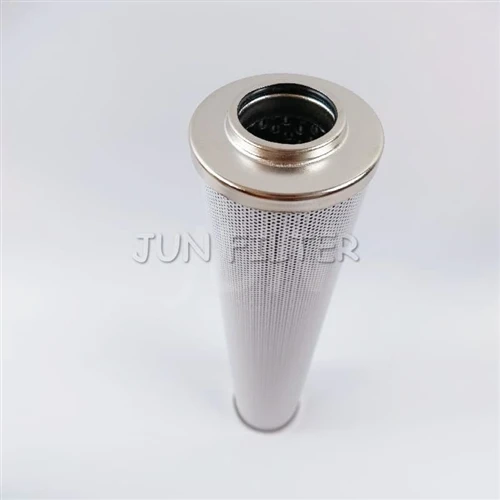
Melt-Blown Filter Element Production Process
1. Raw Material Preparation & Melting
Polymer pellets (such as Polypropylene) are fed into a screw extruder and heated to a molten state (approx. 230°C-280°C) to form a uniform melt.
2. Melt Filtration & Metering
The melt is filtered to remove impurities and then precisely metered by gear pumps to ensure uniform distribution to the melt-blown die heads.
3. Melt-Blown Fiber Formation
The melt is extruded through small orifices in the spinneret and attenuated by high-velocity hot air streams, drawing it into microfibers with diameters of 1-10μm.
4. Fiber Collection & Formation
The microfibers are blown onto a collector (rotating mandrel or conveyor belt), where they entangle and accumulate to form a three-dimensional tubular or sheet structure.
5. Filter Element Shaping & Cutting
Wall thickness, density, and gradient structure are controlled by adjusting collector speed and movement; the continuous tube is then cut into finished filter elements of specified lengths.
6. Functional Treatment (Optional)
Antibacterial agents, electret treatment, or functional powders may be added to impart special properties.